
Navigating the Shift: Understanding Changes in the CBSE Class 9 Syllabus
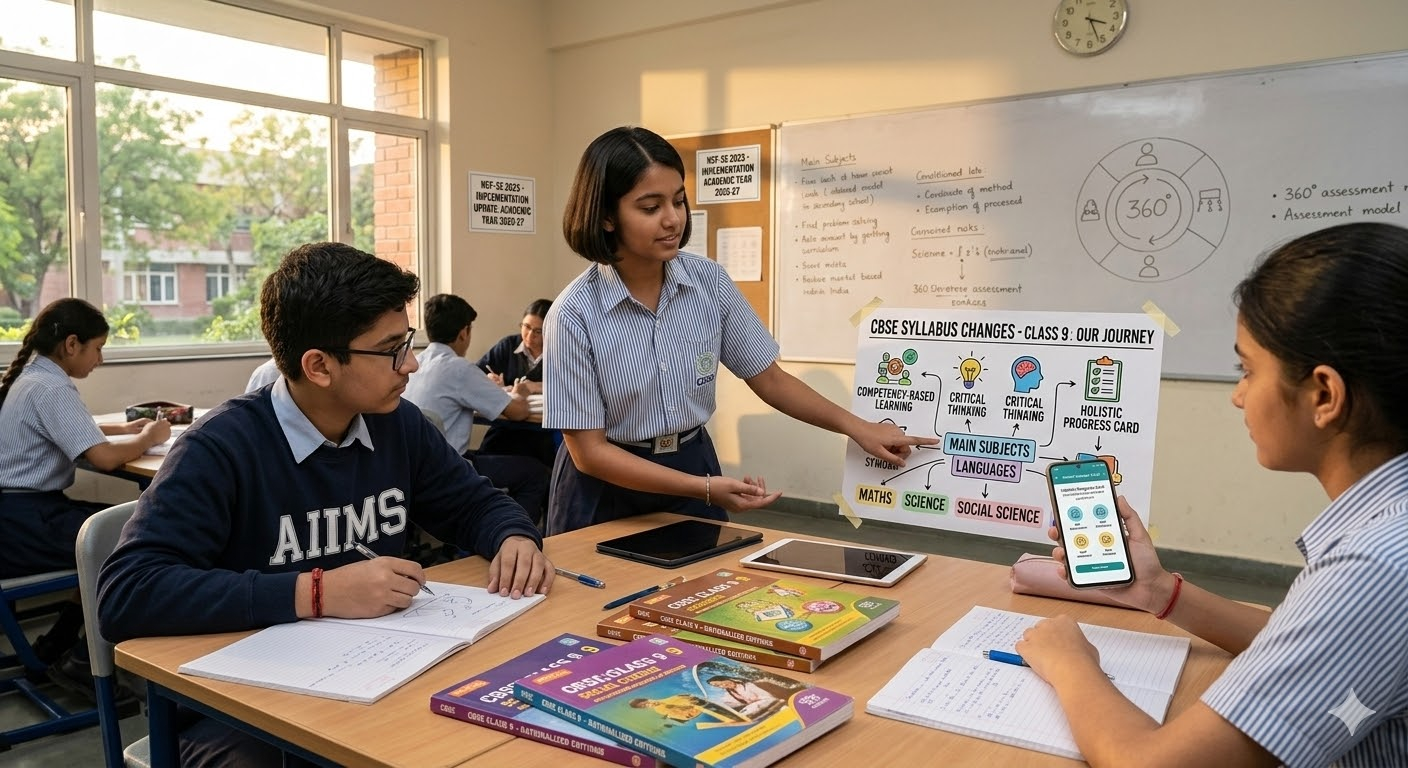
The landscape of secondary education in India is undergoing a significant transformation, driven by the principles of the National Education Policy (NEP) 2020.
The Philosophy Behind the Changes
The core objective of the recent syllabus revisions is to move away from a system heavily reliant on rote memorization and towards one that fosters competency-based learning.
Subject-Wise Analysis of Changes
The rationalization process has seen specific chapters, topics, and exercises being deleted or modified across main subjects.
1. Mathematics
The Class 9 Mathematics syllabus has seen a conscious effort to remove topics that are either repetitive or considered less essential for foundational understanding.
Key Deletions/Modifications:
Rationalization: Chapters like Areas of Parallelograms and Triangles, Constructions, and Probability have often been completely deleted from the examinable curriculum in rationalization drives.
Specific Topics: Within existing chapters, specific topics have been pruned. Examples include:
In Number Systems, the representation of real numbers on the number line using successive magnification.
In Polynomials, certain proofs related to the Remainder Theorem.
In Circles, the motivation behind proving that only one circle passes through three non-collinear points.
In Surface Areas and Volumes, complex problems involving combinations of different solids are sometimes reduced.
2. Science
The Science syllabus has been streamlined to emphasize core scientific principles and their real-world applications.
Key Deletions/Modifications:
Streamlining Biology: The massive chapter on Diversity in Living Organisms has been a frequent candidate for complete removal to lighten the memorization load in Biology.
Chapters on Why Do We Fall Ill? have also seen significant reduction or removal, with a greater focus now on health and diseases being handled formatively. Pruning Physics & Chemistry:
In Is Matter Around Us Pure?, complex methods for separating components of a mixture have been removed.
In Atoms and Molecules, the extensive mole concept has been simplified.
In Sound, technical details like SONAR and the structure of the human ear are sometimes excluded from final evaluations.
Focus on Core Units: Units like Matter, Organization in the Living World, and Motion, Force and Work remain central, but with refined content.
3. Social Science
The Social Science curriculum, which includes History, Geography, Political Science, and Economics, has been revised to reduce content heavy on factual recall and enhance geographical and civic understanding.
Key Deletions/Modifications:
Geography: Map work remains vital, but specific identification of cities and regions in units like Climate and Natural Vegetation and Wildlife has been scaled back from final examinations, becoming more project-oriented. Content heavy on repetitive data in chapters like Population has been prunned.
History: The focus is on critical modern world history, including the French Revolution, the Russian Revolution, and the rise of Nazism.
Other themes have been rationalized to ensure more in-depth study of these transformative events. Political Science & Economics: Chapters on basic democratic concepts, electoral politics, and the working of institutions are prioritized over extensive details that might overlap with upper classes.
4. Languages
In English and Hindi, the syllabus emphasizes developing four essential skills: reading, writing, speaking, and listening. While specific stories or poems in textbooks like Beehive and Moments might be updated, the greater focus is on competency-based evaluation through grammar, comprehension passages, and creative writing.
Assessment and Grading: Beyond Just Marks
The changes are not just in 'what' is taught, but also in 'how' students are assessed.
Internal Assessment Components (20 Marks):
Periodic Tests: Usually a set of three tests to provide regular feedback.
Portfolio: Submissions of classwork, creative projects, and student achievements.
Subject Enrichment Activity: Practical work in science, map work in social science, or speaking and listening tests in languages.
Multiple Assessment: Short quizzes, oral tests, and classroom discussions.
The grading system uses a nine-point scale based on relative ranking within the class, from A1 (top eighth) down to E (needs improvement).
Looking Ahead: Continued Evolution
The current date is March 2026.
However, the educational world is abuzz with anticipation for the transformations expected from the upcoming 2026-27 academic session. This session is set to be a milestone in the full-scale implementation of the National Curriculum Framework for Secondary Education (NCF-SE) 2023. Wide-ranging discussions and pilot projects suggest that significant changes are on the horizon. Key areas of focus for the next session include:
Credit-Based System: A proposed credit framework that assigns credits to different subjects, aiming to create parity between general and vocational streams and providing a more holistic summary of a student's learning journey.
Flexible Subject Structure: Hints are strong that the number of mandatory subjects might change, moving from a rigid structure of five to perhaps seven subjects, giving students more choice, especially regarding vocational courses and a three-language formula.
Open-Book Assessments: A pilot study on open-book exams in core subjects has reportedly been successful.
There is strong indication that these might be introduced, not for final exams immediately, but integrated into school-based internal assessments for language, mathematics, science, and social science. The aim is to test application and synthesis of knowledge rather than fact recall. Integration of New Tech: Curriculum updates in upcoming sessions will likely place a renewed emphasis on AI and computational thinking across subjects.
Holistic Progress Cards: Traditional report cards are expected to be replaced by 360-degree 'holistic progress cards' that assess a student’s cognitive, affective, psychomotor, and aesthetic domains, incorporating self-assessments and peer feedback.
While the 2025-26 session maintained a streamlined version of the existing model, it has served as a critical preparation phase. All stakeholders must keep a keen eye on official CBSE announcements, as the 2026-27 session promises to deliver some of the most profound structural changes in Indian secondary education in decades. These changes, although potentially unsettling at first, are designed to create an education system that is truly 21st-century-ready, equitable, and capable of nurturing the diverse talents of every child.
- Log in to post comments